.

THE PEOPLE'S REPUBLIC OF CALIFORNIA - This site is dedicated to exposing the continuing Marxist Revolution in California and the all around massive stupidity of Socialists, Luddites, Communists, Fellow Travelers and of Liberalism in all of its ugly forms.


"It was a splendid population - for all the slow, sleepy, sluggish-brained sloths stayed at home - you never find that sort of people among pioneers - you cannot build pioneers out of that sort of material. It was that population that gave to California a name for getting up astounding enterprises and rushing them through with a magnificent dash and daring and a recklessness of cost or consequences, which she bears unto this day - and when she projects a new surprise the grave world smiles as usual and says, "Well, that is California all over."

- - - - Mark Twain (Roughing It)

Monday, December 28, 2015

California Faces Lost Decades in Solving Drought


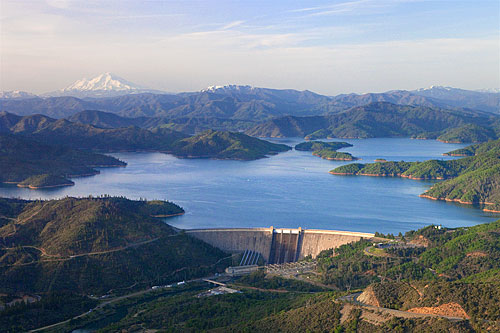
Shasta Dam

A Government of Morons

  • Endless money is spent on welfare and to pander to illegal aliens. But it is too hard for Democrats or Republicans to add a few feet to the tops of dams.


SHASTA LAKE, Calif.— (Wall Street Journal)  -  One of the seemingly easiest ways to expand California’s water supply would be to raise the height of the 602-foot Shasta Dam by 18.5 feet, adding the equivalent of another reservoir to the drought-stricken state.
The federal Bureau of Reclamation has been studying the idea to some degree since 1980. But regulatory delays and pushback from critics—including a Native-American tribe that has performed war dances at the dam—prevented it from happening.
Raising the dam, which is a fairly common procedure though not on this magnitude, would cost about $1.3 billion. Getting the project funded through Congress and other sources, however, would be a challenge.

The hurdles in expanding the Shasta Dam underscore a broader problem in the nation’s most populous state as it grapples with a devastating four-year drought: state and federal officials haven’t significantly upgraded California’s water infrastructure in decades.
Building water projects amid divisions among residents in Northern California, where most of the water can be found, and Southern California, where most residents live, is a challenge. There are about 1,400 dams under state and federal control in California and roughly 1,300 reservoirs, officials said.
Since the last major state or federal dam was completed in 1979, California’s population has grown to 39 million people from 23 million.
“We’ve added millions of people and yet we’re operating on a 1960s infrastructure for the entire state,” said Jeffrey Kightlinger, general manager of the Metropolitan Water District of Southern California, which serves 19 million residents.
The heyday of large-scale projects to move water to farms and urban areas in California ended during the tenure of Gov. Edmund G. “Pat” Brown in the 1960s, and little has taken place since his son, current Gov. Jerry Brown, first led the state in the 1970s and early 1980s.
Read More . . . .


Tuesday, December 22, 2015

California builds homes in the desert during a drought


A Government of Fools

  • In only five years California has added 1.8 million new water using people to the state. Now the fools in government are going to encourage even more population growth in hot desert areas where there is no water.
  • But what the Hell.   Let's keep pouring millions and millions of new people on to the freeway and surface street system until we are packed in shoulder to shoulder like an ant colony.


(San Jose Mercury News)  -  For the first time since ordering water cuts across California, state officials propose easing the reductions for communities with rapid housing and business growth or sizzling hot climates.
In the Bay Area, water agencies most likely to benefit are in fast-growth areas like Silicon Valley, or in hot inland areas like Concord, Brentwood, Dublin and Pleasanton, state water officials said. The biggest beneficiaries statewide likely would be areas with the hottest climates like Sacramento, Fresno, Bakersfield and Palm Springs.

While the proposal was made amid a series of storms that has begun to replenish reservoirs, state officials said the proposed change in the emergency rules was not a response to the rain and snow, but to persistent complaints from some communities that the reduction targets are unfair to them.


"We're talking about modest adjustments in response to concerns about equity," said Max Gomberg, the state Water Resources Control Board's climate and conservation manager.
"We are responding cautiously because the drought is not over," he said.
Under the proposal released by the state board, water suppliers could get a maximum reduction of up to 4 percentage points in their state-assigned water cuts, which vary from 4 to 36 percent. The state's 25 percent conservation target would drop to 22 percent under this proposal.
Hot climate water agencies say it is unfair that their required cutbacks fail to provide some allowance for the extra water used on landscaping in their area. Water agencies can be fined for falling short of the targets.
One environmentalist called it a "bad idea" to change rules during a drought emergency.
"It sends the wrong message to move back from the conservation target," said Sara Aminzadeh, executive director of the California Coastkeeper Alliance. "We have done such a good job of communicating what we need to do for conservation, and to add this new element is confusing."
Aminzadeh said the state board should make no change until April, when officials know how much snow and rain will have fallen for the season. "Why change now?" she asked.
Read More . . . .


Riverlakes Golf Course in Bakersfield
Developers select names that have nothing to do with reality. Simply, there is no river and there are no lakes except man made ones.  California keeps adding millions of new water sucking houses for people and new businesses with no real thought about overpopulation or where the water will come from in a desert. 

Saturday, December 19, 2015

University of California pulls $30 million from prisons in orgy of political correctness


Idiots on Parade

  • Statistics show that most crime is Black-on-Black. But somehow it is "racist" to put Black people in jail for committing crimes against Black people.


(Reuters)  -  The University of California system said on Friday it will drop its roughly $30 million worth of investments in private prison companies following demands from a black student group.
The decision comes amid a wave of student protests against racism at college campuses across the country as well as the Black Lives Matter civil rights movement against the U.S. criminal justice system, which disproportionately impacts black people.
The UC system's chief investment officer, Jagdeep Singh Bachher, made the decision after meeting with students of the Afrikan Black Coalition, university spokeswoman Dianne Klein said.
Klein said the UC system has a policy against "blanket divestment," but made the decision after further review.
"This made sense given our conclusion that, based on risk over the next several years, these holdings were not a good investment for a long-term investor such as UC," Klein said.
Klein said the amount invested was less than $30 million, a tiny fraction of the UC system's $100 billion investment portfolio. Klein said she did not know exactly which private prison companies the system held shares in or exactly how much money was invested.
The coalition, a California-wide student group, said the UC system had $25 million invested in Corrections Corporation of America and The Geo Group.
Read More . . . .


Thursday, December 17, 2015

California adds nearly 350,000 people


And every damn one of them 
is on the freeway

  • What quality of life?  How about zero population growth?  Let's address the people already here. Importing more and more people does not improve our quality of life. Plus each new resident sucks down more water and clogs the freeways and streets.


(Fox News)  -  New figures show that California added nearly 350,000 people over a one-year period, bringing its total population to a smidge under 39.1 million.
The Department of Finance released the numbers Wednesday. The growth covers the period July 1, 2014, to July 1, 2015.
California, the nation's most populous state, added 346,000 people, with most of the growth caused by what's called a "natural increase." There were 507,000 births and 245,000 deaths.
The rest comes from migration into and out of the state, resulting in 84,000 new people. California added about 145,000 people from other countries and lost 61,000 to other states.

"We're getting just below 1 percent of growth a year. It shows the state's recovery since the recession is ongoing," said John Malson, the state's chief demographer.
California has gained more than 1.8 million people since the 2010 U.S. Census, department officials said.
Much of the growth has been in urban coastal counties, although inland counties have posted growth in recent years as people move away from urban centers for more affordable housing.
Of the state's 58 counties, five accounted for more than half of California's population growth. They are the Southern California counties of Los Angeles, Orange, San Diego and Riverside, and the Northern California county of Santa Clara.
Smaller counties in remote areas continue to lose people or post smaller gains, department officials said.
Lassen County, for example, in northeastern California lost the most number of people: 815. Los Angeles County gained the most with nearly 69,000 added, bringing its total population to nearly 10.2 million.
San Diego is the state's second most populous county, followed by Orange, with more than 3 million people each.
Fifteen counties posted a population growth of more than 1 percent, including San Joaquin and Fresno in Central California.
The Northern California Bay Area counties of San Francisco, San Mateo, Santa Clara and Contra Costa also grew by more than 1 percent each.
Read More . . . .


Monday, December 14, 2015

San Diego desalination plant goes online


Finally Water Flows
  • The Carlsbad project endured 14 lawsuits and more than a decade of negotiations and red tape before Poseidon could break ground. Construction took three years.
  • Meanwhile most of California ignores desalination and prays for rain as the solution.


Read more here: http://www.miamiherald.com/news/nation-world/national/article49638835.html#storylink=cpy

(Miami Herald)  -  The newest weapon in the war on drought in California has arrived, an engineering marvel that will harvest drinking water from the ocean on a scale never before seen in the Western Hemisphere.
A giant water desalination plant will open this week north of San Diego, tucked behind a power plant across the street from Tamarack State Beach. It will produce 50 million gallons of fresh water each day, meeting 7 percent to 10 percent of the San Diego County Water Authority’s demands and buffering the region against supply shortages for decades to come.
Oh, and it will be expensive – ridiculously so, in the minds of some critics. Built by privately owned Poseidon Water of Boston for $1 billion, the plant will deliver some of the priciest water found anywhere in California. It will cost twice as much as the water San Diego gets from the Metropolitan Water District of Southern California, which provides the bulk of San Diego’s supplies.


Yet San Diego officials say the Carlsbad project, representing a comparatively small slice of its overall water supply, will add only a few dollars a month to customer bills. Besides, with Metropolitan’s prices relentlessly rising, San Diego officials say desalination eventually will become competitive with the region’s other water sources.
What’s happening in Carlsbad could have implications for statewide water policy. The first major desalination facility built in California and the largest in the Western Hemisphere, it could establish desalination as a potentially major tool in solving the state’s long-term water stress.
“I think we’ve blazed a trail,” said Sandy Kerl, deputy general manager of the San Diego water authority. “It’s being watched with a lot of interest.”
The public will get its first glimpse at the grand opening Monday. Commercial operations will start later this month, with the arrival of the first flows of desalinated water at the authority’s aqueduct 10 miles inland. It marks a pivotal moment in a journey that began 15 years ago, when the plant was initially proposed.
“If it’s successful, as I believe it will be, others will follow,” said Peter MacLaggan, the Poseidon vice president overseeing Carlsbad.


Read more here: http://www.miamiherald.com/news/nation-world/national/article49638835.html#storylink=cpy

Read more here: http://www.miamiherald.com/news/nation-world/national/article49638835.html#storylink=cpy
Read More . . . .


Saturday, December 12, 2015

California Democrat withdraws support for the high-speed rail project


RARE - A Sane Democrat


(Los Angeles Times)  -  The rock-solid Democratic support in Sacramento for the bullet train, which has endured despite legal and financial setbacks in recent years, has developed a political fissure.

Assemblywoman Patty Lopez (D-San Fernando) says she is withdrawing her support for the project, and she says five other Democrats in the Legislature are reviewing their positions.

Lopez said in an interview that the project would damage her mostly Latino, working-class district, which includes Pacoima, San Fernando and Sylmar. The rail route would cut through the district.

"I don't see any benefit," said Lopez, who said it would drive up crime and eliminate businesses in her district. "People are really upset."
Lopez

Lopez said the matter should go back to voters, who approved $9 billion in funding for the project in 2008. Lopez said the state has higher priorities, including water, jobs and homelessness, that outweigh the high-speed rail system.

"The money we are going to spend on it is crazy," she said. Public opinion polls have found that support for the project has eroded as costs have risen.

Last year, however, Lt. Gov. Gavin Newsom said he opposed the project, and he argued that other Democrats secretly were against it, despite the overwhelming support of organized labor. Newsom, who is running to succeed Brown as governor in 2018, cited the growing costs and lack of adequate funding to complete the system.

For Lopez, the primary issue is the effect on her low-income community, which has been hurt historically by the construction of three freeways, garbage dumps and other decisions by political power brokers in the state.

This summer, hundreds of protesters from her district showed up at a rail authority board meeting in downtown Los Angeles. And only weeks earlier, protesters brought in their own sound system and took control of a rail authority open house in San Fernando that was supposed to highlight the project's benefits.

Lopez showed up at a meeting of community groups known as Save Angeles Forest for Everyone, which drew about 100 residents. She wore a vest bearing patches that depicted the four proposed routes in her district, all of them with red slashes through them.

Unless the rail authority can find a politically acceptable route through the Tehachapi and San Gabriel mountains, the line might never get south of the Central Valley.

Read More . . . .


The 39th District of Assemblywoman Patty Lopez.
The city of San Fernando, like many other cities, has been the target
of the corrupt high speed rail system.

Amtrak rail lines in California.
.
Nothing to Steal
An intelligent person would simply connect the Amtrak line that dead ends in San Luis Obispo with the Amtrak line at San Jose.  For a tiny fraction of the cost of the insane "high speed" rail fraud most of the state from Mexico to Sacramento would be connected by rail.
.
Instead countless billions will be pissed away as payback to the businesses and unions that fund the campaigns of the Sacramento hacks.  All the special interests have their snouts in the trough of corruption.
 

Wednesday, December 9, 2015

Uranium contaminates water in Central California


Too Many People

  • As a Conservative John Muir Conservationist I see overpopulation destroying the Golden State's natural beauty, health and quality of life. But the politicians from both parties keep paving over the state.


FRESNO --  (Associated Press) -- In a trailer park tucked among irrigated orchards that help make California's San Joaquin Valley the richest farm region in the world, 16-year-old Giselle Alvarez, one of the few English-speakers in the community of farmworkers, puzzles over the notices posted on front doors: There's a danger in their drinking water.
Uranium, the notices warn, tests at a level considered unsafe by federal and state standards. The law requires the park's owners to post the warnings. But they are awkwardly worded and in English, a language few of the park's dozens of Spanish-speaking families can read.

"It says you can drink the water -- but if you drink the water over a period of time, you can get cancer," said Alvarez, whose working-class family has no choice but keep drinking and cooking with the tainted tap water daily, as they have since Alvarez was just learning to walk. "They really don't explain."
Uranium, the stuff of nuclear fuel for power plants and atom bombs, increasingly is showing in drinking water systems in major farming regions of the U.S. West -- a naturally occurring but unexpected byproduct of irrigation, of drought, and of the overpumping of natural underground water reserves.

In this Sept. 14, 2015 photo, Dora Martinez cooks food at her home in a trailer park near
Fresno, Calif. Residents of the trailer park receive notices warning that their well water
contains uranium at a level considered unsafe by federal and state standards.
(AP Photo/John Locher) (John Locher/AP)

An Associated Press investigation in California's central farm valleys -- along with the U.S. Central Plains, among the areas most affected -- found authorities are doing little to inform the public at large of the growing risk.

That includes the one out of four families on private wells in this farm valley who, unknowingly, are drinking dangerous amounts of uranium, researchers determined this year and last. Government authorities say long-term exposure to uranium can damage kidneys and raise cancer risks, and scientists say it can have other harmful effects.
In this swath of farmland, roughly 250 miles long and encompassing major cities, up to one in 10 public water systems have raw drinking water with uranium levels that exceed federal and state safety standards, the U.S. Geological Survey has found.

More broadly, nearly 2 million people in California's Central Valley and in the U.S. Midwest live within a half-mile of groundwater containing uranium over the safety standards, University of Nebraska researchers said in a study published in September.
Everything from state agencies to tiny rural schools are scrambling to deal with hundreds of tainted public wells -- more regulated than private wells under safe-drinking-water laws.
That includes water wells at the Westport Elementary School, where 450 children from rural families study outside the Central California farm hub of Modesto.
At Westport's playground, schoolchildren take a break from tether ball to sip from fountains marked with Spanish and English placards: "SAFE TO DRINK."
Meanwhile, the city of Modesto, with a half-million residents, recently spent more than $500,000 to start blending water from one contaminated well to dilute the uranium to safe levels. The city has retired a half-dozen other wells with excess levels of uranium.

Read More . . . .


Monday, December 7, 2015

Nevada GOP Governor rips Jerry Brown on guns


Yes, Jerry Brown is an Asshole
Nevada's Hispanic Republican Governor tears into 
Loony-Tunes Gov. Jerry Brown


Carson City, Nev.  -  Nevada Republican Gov. Brian Sandoval is hitting back at comments California Gov. Jerry Brown made about other states' gun laws after the deadly shooting in San Bernardino.

Brown said earlier this week that Nevada and Arizona's looser gun laws are "a gigantic backdoor through which any terrorist can walk."
Governor Jerry Brown (D)
(AP file photo)
The Democratic governor was responding to some California lawmakers' call for tightening the state's already strict gun laws.
In a statement Sunday, Sandoval spokeswoman Mari St. Martin called Brown's characterization "wrong and irresponsible."
St. Martin says his "political rhetoric is discouraging to hear at a time when all Americans are looking for thoughtful, honest leadership."
She says the Republican Sandoval has always made safety a top priority.
The San Bernardino attackers purchased some of their weapons legally in California.
On Saturday night, Arizona Gov. Doug Ducey criticized Brown's comments. 
In a statement, the Republican said, "All of Arizona mourns for the victims in California. Not only will we be ignoring Gov. Brown's advice, but I call on him to retract his incredibly thoughtless and ill-advised comments."

Read more here: http://www.sacbee.com/news/state/california/article48347680.html#storylink=cpy
Sacramento Bee . . . .

Saturday, December 5, 2015

Obama imports Muslims to Redlands, California


Democrats Import "Refugees" into SoCal
Democrats prove yet again that they don't 
give a crap about American citizens

(Breitbart News)  -  The area around San Bernardino, California was the site of intense debates about Muslim immigration in the immediate days before Wednesday night’s horrific mass shooting.

Police searched a home in Redlands, California, fifteen minutes away from where the shooting occurred as part of its investigation into the suspects. Thus far, the name Syed Farook has been given as a suspect in the case.
The U.S. State Department recently chose Redlands as the proposed site of a Syrian refugee settlement due to its already active Middle Eastern immigrant community. Catholic Charities was identified as a broker for the federal government program.
Citizens in Redlands, California took action in response to the area’s Muslim immigration threat, appearing before the town’s mayor in a public forum in October to voice their concerns.
Groups including Redlands Tea Party, Redlands Townhall, and Redlands Tea Party Patriots expressed concern about this issue, and two op-eds (HERE AND HERE) appeared in local publications.
The situation got so heated that the Islamic Center of Redlands held an “Open Mosque Day” in mid-October to try to quell the community’s concerns.
“I don’t care to be politically correct any longer. This is just a plan for disaster,” one concerned woman told town officials at the public forum in video footage obtained by Breitbart News.
Read More . . . .


Wednesday, December 2, 2015

Delta, rail battles loom in 2016 California elections


Draining the Sacramento Delta Dry

  • A chance to gut Jerry Brown's twin schemes of draining the Sacramento Delta dry to water golf courses in Southern California and building a useless bullet train may be on the ballot in 2016.


(The Daily Democrat)  -  Gov. Jerry Brown could have a huge battle on his hands next year against ballot-measure proponents asking voters to essentially kill his two most beloved public works projects — the bullet train and his proposed twin water tunnels under the Delta.
Two prominent Republicans are proposing a measure that would divert about $8 billion not yet spent from 2008’s highspeed rail bond measure, using it instead for surface water and groundwater storage projects. And another measure that already has garnered enough signatures to make next November’s ballot will ask voters to upend how California deals with bond financing for many public infrastructure projects — a direct attack on Brown’s plan for the two massive tunnels, aimed at moving more water to the Central Valley and Southern California.
Critics say both measures would give the relatively small number of Californians who actually vote — and the increasingly large amount of money spent to influence them — more sway over what the Golden State will spend on infrastructure for decades.
“States that live by the initiative die by the initiative,” warned Richard Little, former director of the University of Southern California’s Keston Institute for Public Finance and Infrastructure Policy. “Democracy does not necessarily imply everyone gets to vote on everything. Eventually, you end up like India, where they vote on everything all the time, and nothing gets done.“ Particularly with longterm infrastructure decisions that take years or decades to execute, “at some point, decisions have to be final,” he said, “as opposed to ‘Whoops, let’s have another review.’” 

Voters approved 2008’s Proposition 1A — a $9.95 billion bond issue, amounting to about a quarter of an 800-mile high-speed rail line’s estimated cost — by a vote of 52.7 to 47.3 percent. Since then, the rail project’s estimated cost has ballooned to $68 billion, officials have been accused of secrecy and mismanagement, the Republican-led Congress wants to defund it, ! and even some supporters have wavered. A groundbreaking ceremony for the project was held in January, but most of the roughly $2 billion spent so far has been for planning and design.
The measure proposed late last week by former state Senate GOP leader Bob Huff, R-Brea, and Board of Equalization Vice Chairman George Runner would siphon away what remains from Proposition 1A to build new surface water and groundwater storage. It also would re-appropriate about $2.7 billion not yet spent from last year’s Proposition 1 water bond — the product of a deal laboriously brokered by Brown and legislative leaders, including Huff.
Runner said the measure would meet California’s water needs without raising taxes or adding more debt, and Huff noted the state’s economic survival depends on a reliable water supply.
That’s music to the ears of some drought-weary, rail-dubious voters.
“It’s good for the voters to get the ability to make a decision on the two most critical infrastructure issues facing California,” said Aaron Fukuda, of Hanford, co-chairman of Citizens for California High-Speed Rail Accountability, a community group that tried to kill the project in court.

Fukuda likes the idea of “putting voters in the position to be an integral part, not just a green light, of where we’re going to put the money.”
“Sacramento has this idea that once they get something passed, they can start running off in weird directions,” he said, adding it’s fair to pit high-speed rail and water storage against each other on a seesaw.
The proposed measure would add a new section to the California constitution to set drinking water and irrigation as the state’s primary beneficial water-use priorities,which some might see as an end-run around environmental protection laws. Neither the National Resources Defense Council nor Sierra Club California responded to requests for comment.
There might be another obstacle on the tracks, too. Brown wants to use revenue from the state’s capand- trade carbon emissions program to help leverage private investment in the rail project — and if those investments are revenue bonds, the initiative already bound for next November’s ballot would require that voters get the final say.
The “No Blank Checks Initiative” would require that voters be asked to approve every public infrastructure bond issue of more than $2 billion that requires new or higher taxes or fees. And it would apply not only to future bonds but to previously approved projects if the remaining bond authorization exceeds $2 billion.
State and local general obligation bonds — borrowing guaranteed by the government’s full faith and credit, repaid with general tax revenue — already must be put to voters. This measure would extend that requirement to many revenue bonds, repaid using designated funding streams related to those projects — for example, bonds issued for a bridge’s construction or repair, to be repaid by bridge tolls.
Its aim is to short-circuit Brown’s desire that bonds, to be repaid by water users, be used to fund his $15 billion Delta tunnel plan. Proponent Dean Cortopassi, a Stockton farmer and tunnel opponent, and his wife put up $4 million to circulate the qualification petitions.
Deep-pocketed opponents are lining up, including the California Chamber of Commerce and the State Building and Construction Trades Council.

Read More . . . .