.

THE PEOPLE'S REPUBLIC OF CALIFORNIA - This site is dedicated to exposing the continuing Marxist Revolution in California and the all around massive stupidity of Socialists, Luddites, Communists, Fellow Travelers and of Liberalism in all of its ugly forms.


"It was a splendid population - for all the slow, sleepy, sluggish-brained sloths stayed at home - you never find that sort of people among pioneers - you cannot build pioneers out of that sort of material. It was that population that gave to California a name for getting up astounding enterprises and rushing them through with a magnificent dash and daring and a recklessness of cost or consequences, which she bears unto this day - and when she projects a new surprise the grave world smiles as usual and says, "Well, that is California all over."

- - - - Mark Twain (Roughing It)

Showing posts with label Drought. Show all posts

Monday, May 23, 2022

Loon Newsom vows water use limits


A Water Shortage???
Bullshit
.
The entire Pacific Ocean is just sitting there. But Leftist Loons and their Sheeple voters refuse to build desalination plants.


(Reuters) - California Governor Gavin Newsom on Monday warned he would order strict cutbacks on water usage statewide if businesses and residents did not slash their own consumption in the face of a severe drought.

Newsom issued the ultimatum during a meeting a meeting with California's largest water agencies ahead of what experts worry could be another hot, dry summer on the heels of more than three years of drought.

"Every water agency across the state needs to take more aggressive actions to communicate about the drought emergency and implement conservation measures,” Newsom said, according to a transcript of his remarks issued by his office.

Already the Metropolitan Water District in Southern California has ordered residents of Los Angeles, Orange, San Diego, Riverside, San Bernardino and Ventura Counties to water lawns and gardens no more than twice a week.

The agency said it would fine residents $2,000 if they are caught watering lawns too often.

msn.com


Thursday, March 9, 2017

This picture shows how much California is sinking


A Land of Crazy People

  • We keep building more water using homes, businesses and farms thinking water will "magically" appear on command.


(CNBC)  -  This picture from NASA's Earth Observatory shows how much land in California's Central Valley is sinking, due primarily to the drawing of groundwater during periods of drought.
Heavy rains have fallen on many parts of the state this winter, but the image above is a reminder of the lingering effects of drought, even in wetter times.
As the legend at the bottom of the picture suggests, the yellowest areas are those with the greatest degree of subsidence (the term for sinking land) and the bluest areas are those with the least.
As might be expected, the largest degree of subsidence occurred in southern California where the drought struck the hardest. In some places, the land sunk by nearly 30 feet.
California's Department of Water Resources commissioned NASA's Jet Propulsion Laboratory to collect and analyze satellite data during the state's most recent drought, resulting in an initial report in 2015, and subsequent updates. The most recent shows land continued to sink since 2015, at a rate of as much as 2 feet per year in the worst spots.
"The rates of San Joaquin Valley subsidence documented since 2014 by NASA are troubling and unsustainable," DWR Director William Croyle is quoted saying in a recent post from NASA Earth Observatory. "Subsidence has long plagued certain regions of California. But the current rates jeopardize infrastructure serving millions of people. Groundwater pumping now puts at risk the very system that brings water to the San Joaquin Valley. The situation is untenable."
One of the problems that stems from the sinking land is that it fills in the underground gaps where groundwater collects when rain occurs, reducing storage capacity.
NASA also notes that state and federal water agencies have spent an estimated $100 million on related repairs since the 1960s.
The state passed its first-ever regulations around the pumping of groundwater in 2014.
Read More . . . .

That sinking feeling
The sign reads, " San Joaquin Valley California Subsidence, 3M 1925 - 1977."  The Central Valley has been sinking from over pumping for a century.

(Water California.org)

Tuesday, March 8, 2016

Desalination plant for Baja California, not Alta California


Baja California Gov. Francisco Vega de Lamadrid, at center in beige jacket, presides at a groundbreaking ceremony in the community of La Chorera, site of desalination plant set to open in 2017 to supply residents in the San Quintin agricultural region. — Gob. de Baja California

El NiƱo is a bust, and MEXICO acts

California political hacks sit on their hands while Mexican politicians build desalination plants.


 (San Diego Union Tribune) — A New York City-based company working with two Mexican partners has launched construction of an ocean water desalination plant in the agricultural region of San Quintin some 160 miles from the San Diego border.
Scheduled to open in the summer of 2017, the plant would provide 5.8 million gallons of water daily to more than 100,000 residents of the region.
The cost of the project is about $32 million at current exchange rates. It is the first to be approved under Baja California’s new public-private partnership law.
“This would not have been possible without this new very important tool that we have in Baja California,” Baja California Gov. Francisco Vega de Lamadrid said at a groundbreaking ceremony on Saturday.
The financing and construction of the facility is being carried out by a consortium made up of RWL Water Group and two Mexican partners, Libra Ingenieros Civiles and R.J. Ingenieria. Under the agreement, the group would operate the plant for 30 years.
RWL Water’s founder and chairman is Ronald S. Lauder, a former U.S. ambassador to Austria who also served as the president of the World Jewish Congress.
San Quintin is an important agricultural region that specializes in export-oriented produce, such as strawberries, tomatoes and cucumbers. But unlike other areas of Baja California, it does not receive water from the Colorado River and has struggled with a limited water supply.
The future facility, located in the fishing community of La Chorera, is one of two desalination plants now under construction in Baja California. A similar-sized reverse-osmosis plant in the port city of Ensenada is scheduled for opening in April 2017.
The state of Baja California also has been pursuing the possibility of a public-private partnership to build a third desalination plant with a capacity for 100 million gallons a day, with the possibility of selling some of that water to U.S. consumers.
Read More . . . .

The drought goes on in Alta California

Tuesday, March 1, 2016

California Reservoirs Are Dumping Water in a Drought


California - A State of Lunatics
Billions spent on a bullet train to nowhere while 
water is dumped out to sea during a drought.


(KQED)  -  There’s a rule in California that may seem bizarre in a drought-stricken state: in the winter, reservoirs aren’t allowed to fill up completely.

In fact, even as this post goes up, a handful of reservoirs are releasing water to maintain empty space.

The practice, which has long inflamed combatants in California’s water wars, is due to a decades-old rule designed to protect public safety. If a major winter storm comes in, reservoirs need space to catch the runoff and prevent floods.

But with advances in weather forecasting, some say this preemptive strategy is outdated. A new, “smart” flood control system could save water in years when Californians need it most.

At one of the state’s major reservoirs — Folsom Lake, east of Sacramento — the volume of water spilling from the dam has swollen eight-fold in the past few weeks, sending billions of gallons downstream, much of it into San Francisco Bay.

Dumping water out to sea during a drought

Early in February the reservoir reached a key threshold: 60 percent full, which is the highest water level allowed during the winter months, according to rules from the U.S. Army Corps of Engineers and the Sacramento Area Flood Control Agency.

Last year, most of the reservoir was a dry, dusty lakebed.

“What reservoir was left was confined to the old river channels before we built the dam,” says Drew Lessard of the U.S. Bureau of Reclamation, the federal agency that manages the reservoir.

Just an average-size winter storm can send huge volumes of water down the American River into Folsom Reservoir, boosting the lake by 10 percent or more. A major storm can produce dramatically more than that.

Sitting 40 percent empty allows the reservoir to act as a buffer against floods, gulping the runoff without overflowing. In years where the upstream reservoirs are fuller, Folsom Reservoir is required to remain 60 percent empty.

Read More . . . .


Friday, February 26, 2016

El NiƱo a bust, the drought goes on


And the Politicians are Clueless

  • The political hacks keep authorizing the building more and more water using homes and businesses during a drought.
  • California's population keeps increasing. The quality of life keeps decreasing.


(Capital Public Radio)  -  The U.S. Drought Monitor says warmer weather has increased concerns of early snow melt in California and the overall trend is for the multiyear drought to continue or even worsen.
"Out west, progressively warmer weather heightened concerns of early snow melt, with early-week rain and mountain snow falling short of weekly normals and doing little to ease long-term drought," according to the weekly report released Feb. 25.
"Despite some welcomed rain and mountain snow at the beginning of the weekly drought assessment period, a return to dry, warmer weather by week’s end renewed concerns of a sub-par Water Year even with the ongoing strong El NiƱo," the update noted.
The overall trend was toward maintaining or increasing the multiyear drought in California and other parts of the western U.S.
The Drought Monitor intensity levels are Abnormally Dry, Moderate, Severe, Extreme and Exceptional drought.
California remains 99.5 percent abnormally dry, 94 percent moderate, 81 percent severe, 61 percent extreme and 38 percent in exceptional drought.

"In the core drought areas of California and western Nevada, welcomed early-week rain and mountain snow gave way to warm, dry weather," the report says. "Despite locally impressive precipitation totals during the 7-day period (ending Feb. 23 at 4 a.m., PST), wetter-than-normal conditions for the week were confined to the northern-most counties in California as well as portions of the Sierra Nevada."
But precipitation over the past two weeks "has fallen well short of normal over most of the state."
"Nevertheless, a boost to northern California’s SWE (snow water equivalent) and reservoir storage led to a small reduction of Extreme Drought (D3). However, the recent overall trend toward warmer, drier weather - despite the ongoing strong El NiƱo - has raised concerns over increasing short-term drought impacts in addition to the region’s ongoing long-term ("L" Impact) drought.
"To illustrate, a pronounced pocket of short-term dryness extends from the foothills of the San Jacinto Mountains southeast of Los Angeles northwestward to Santa Barbara, where rainfall has averaged a meager 33 to 50 percent of normal during the current Water Year (since October 1)."
Read More . . . .


Monday, December 28, 2015

California Faces Lost Decades in Solving Drought


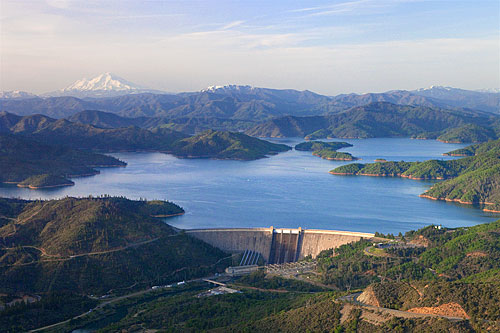
Shasta Dam

A Government of Morons

  • Endless money is spent on welfare and to pander to illegal aliens. But it is too hard for Democrats or Republicans to add a few feet to the tops of dams.


SHASTA LAKE, Calif.— (Wall Street Journal)  -  One of the seemingly easiest ways to expand California’s water supply would be to raise the height of the 602-foot Shasta Dam by 18.5 feet, adding the equivalent of another reservoir to the drought-stricken state.
The federal Bureau of Reclamation has been studying the idea to some degree since 1980. But regulatory delays and pushback from critics—including a Native-American tribe that has performed war dances at the dam—prevented it from happening.
Raising the dam, which is a fairly common procedure though not on this magnitude, would cost about $1.3 billion. Getting the project funded through Congress and other sources, however, would be a challenge.

The hurdles in expanding the Shasta Dam underscore a broader problem in the nation’s most populous state as it grapples with a devastating four-year drought: state and federal officials haven’t significantly upgraded California’s water infrastructure in decades.
Building water projects amid divisions among residents in Northern California, where most of the water can be found, and Southern California, where most residents live, is a challenge. There are about 1,400 dams under state and federal control in California and roughly 1,300 reservoirs, officials said.
Since the last major state or federal dam was completed in 1979, California’s population has grown to 39 million people from 23 million.
“We’ve added millions of people and yet we’re operating on a 1960s infrastructure for the entire state,” said Jeffrey Kightlinger, general manager of the Metropolitan Water District of Southern California, which serves 19 million residents.
The heyday of large-scale projects to move water to farms and urban areas in California ended during the tenure of Gov. Edmund G. “Pat” Brown in the 1960s, and little has taken place since his son, current Gov. Jerry Brown, first led the state in the 1970s and early 1980s.
Read More . . . .


Tuesday, December 22, 2015

California builds homes in the desert during a drought


A Government of Fools

  • In only five years California has added 1.8 million new water using people to the state. Now the fools in government are going to encourage even more population growth in hot desert areas where there is no water.
  • But what the Hell.   Let's keep pouring millions and millions of new people on to the freeway and surface street system until we are packed in shoulder to shoulder like an ant colony.


(San Jose Mercury News)  -  For the first time since ordering water cuts across California, state officials propose easing the reductions for communities with rapid housing and business growth or sizzling hot climates.
In the Bay Area, water agencies most likely to benefit are in fast-growth areas like Silicon Valley, or in hot inland areas like Concord, Brentwood, Dublin and Pleasanton, state water officials said. The biggest beneficiaries statewide likely would be areas with the hottest climates like Sacramento, Fresno, Bakersfield and Palm Springs.

While the proposal was made amid a series of storms that has begun to replenish reservoirs, state officials said the proposed change in the emergency rules was not a response to the rain and snow, but to persistent complaints from some communities that the reduction targets are unfair to them.


"We're talking about modest adjustments in response to concerns about equity," said Max Gomberg, the state Water Resources Control Board's climate and conservation manager.
"We are responding cautiously because the drought is not over," he said.
Under the proposal released by the state board, water suppliers could get a maximum reduction of up to 4 percentage points in their state-assigned water cuts, which vary from 4 to 36 percent. The state's 25 percent conservation target would drop to 22 percent under this proposal.
Hot climate water agencies say it is unfair that their required cutbacks fail to provide some allowance for the extra water used on landscaping in their area. Water agencies can be fined for falling short of the targets.
One environmentalist called it a "bad idea" to change rules during a drought emergency.
"It sends the wrong message to move back from the conservation target," said Sara Aminzadeh, executive director of the California Coastkeeper Alliance. "We have done such a good job of communicating what we need to do for conservation, and to add this new element is confusing."
Aminzadeh said the state board should make no change until April, when officials know how much snow and rain will have fallen for the season. "Why change now?" she asked.
Read More . . . .


Riverlakes Golf Course in Bakersfield
Developers select names that have nothing to do with reality. Simply, there is no river and there are no lakes except man made ones.  California keeps adding millions of new water sucking houses for people and new businesses with no real thought about overpopulation or where the water will come from in a desert. 

Monday, December 14, 2015

San Diego desalination plant goes online


Finally Water Flows
  • The Carlsbad project endured 14 lawsuits and more than a decade of negotiations and red tape before Poseidon could break ground. Construction took three years.
  • Meanwhile most of California ignores desalination and prays for rain as the solution.


Read more here: http://www.miamiherald.com/news/nation-world/national/article49638835.html#storylink=cpy

(Miami Herald)  -  The newest weapon in the war on drought in California has arrived, an engineering marvel that will harvest drinking water from the ocean on a scale never before seen in the Western Hemisphere.
A giant water desalination plant will open this week north of San Diego, tucked behind a power plant across the street from Tamarack State Beach. It will produce 50 million gallons of fresh water each day, meeting 7 percent to 10 percent of the San Diego County Water Authority’s demands and buffering the region against supply shortages for decades to come.
Oh, and it will be expensive – ridiculously so, in the minds of some critics. Built by privately owned Poseidon Water of Boston for $1 billion, the plant will deliver some of the priciest water found anywhere in California. It will cost twice as much as the water San Diego gets from the Metropolitan Water District of Southern California, which provides the bulk of San Diego’s supplies.


Yet San Diego officials say the Carlsbad project, representing a comparatively small slice of its overall water supply, will add only a few dollars a month to customer bills. Besides, with Metropolitan’s prices relentlessly rising, San Diego officials say desalination eventually will become competitive with the region’s other water sources.
What’s happening in Carlsbad could have implications for statewide water policy. The first major desalination facility built in California and the largest in the Western Hemisphere, it could establish desalination as a potentially major tool in solving the state’s long-term water stress.
“I think we’ve blazed a trail,” said Sandy Kerl, deputy general manager of the San Diego water authority. “It’s being watched with a lot of interest.”
The public will get its first glimpse at the grand opening Monday. Commercial operations will start later this month, with the arrival of the first flows of desalinated water at the authority’s aqueduct 10 miles inland. It marks a pivotal moment in a journey that began 15 years ago, when the plant was initially proposed.
“If it’s successful, as I believe it will be, others will follow,” said Peter MacLaggan, the Poseidon vice president overseeing Carlsbad.


Read more here: http://www.miamiherald.com/news/nation-world/national/article49638835.html#storylink=cpy

Read more here: http://www.miamiherald.com/news/nation-world/national/article49638835.html#storylink=cpy
Read More . . . .


Wednesday, December 9, 2015

Uranium contaminates water in Central California


Too Many People

  • As a Conservative John Muir Conservationist I see overpopulation destroying the Golden State's natural beauty, health and quality of life. But the politicians from both parties keep paving over the state.


FRESNO --  (Associated Press) -- In a trailer park tucked among irrigated orchards that help make California's San Joaquin Valley the richest farm region in the world, 16-year-old Giselle Alvarez, one of the few English-speakers in the community of farmworkers, puzzles over the notices posted on front doors: There's a danger in their drinking water.
Uranium, the notices warn, tests at a level considered unsafe by federal and state standards. The law requires the park's owners to post the warnings. But they are awkwardly worded and in English, a language few of the park's dozens of Spanish-speaking families can read.

"It says you can drink the water -- but if you drink the water over a period of time, you can get cancer," said Alvarez, whose working-class family has no choice but keep drinking and cooking with the tainted tap water daily, as they have since Alvarez was just learning to walk. "They really don't explain."
Uranium, the stuff of nuclear fuel for power plants and atom bombs, increasingly is showing in drinking water systems in major farming regions of the U.S. West -- a naturally occurring but unexpected byproduct of irrigation, of drought, and of the overpumping of natural underground water reserves.

In this Sept. 14, 2015 photo, Dora Martinez cooks food at her home in a trailer park near
Fresno, Calif. Residents of the trailer park receive notices warning that their well water
contains uranium at a level considered unsafe by federal and state standards.
(AP Photo/John Locher) (John Locher/AP)

An Associated Press investigation in California's central farm valleys -- along with the U.S. Central Plains, among the areas most affected -- found authorities are doing little to inform the public at large of the growing risk.

That includes the one out of four families on private wells in this farm valley who, unknowingly, are drinking dangerous amounts of uranium, researchers determined this year and last. Government authorities say long-term exposure to uranium can damage kidneys and raise cancer risks, and scientists say it can have other harmful effects.
In this swath of farmland, roughly 250 miles long and encompassing major cities, up to one in 10 public water systems have raw drinking water with uranium levels that exceed federal and state safety standards, the U.S. Geological Survey has found.

More broadly, nearly 2 million people in California's Central Valley and in the U.S. Midwest live within a half-mile of groundwater containing uranium over the safety standards, University of Nebraska researchers said in a study published in September.
Everything from state agencies to tiny rural schools are scrambling to deal with hundreds of tainted public wells -- more regulated than private wells under safe-drinking-water laws.
That includes water wells at the Westport Elementary School, where 450 children from rural families study outside the Central California farm hub of Modesto.
At Westport's playground, schoolchildren take a break from tether ball to sip from fountains marked with Spanish and English placards: "SAFE TO DRINK."
Meanwhile, the city of Modesto, with a half-million residents, recently spent more than $500,000 to start blending water from one contaminated well to dilute the uranium to safe levels. The city has retired a half-dozen other wells with excess levels of uranium.

Read More . . . .


Wednesday, December 2, 2015

Delta, rail battles loom in 2016 California elections


Draining the Sacramento Delta Dry

  • A chance to gut Jerry Brown's twin schemes of draining the Sacramento Delta dry to water golf courses in Southern California and building a useless bullet train may be on the ballot in 2016.


(The Daily Democrat)  -  Gov. Jerry Brown could have a huge battle on his hands next year against ballot-measure proponents asking voters to essentially kill his two most beloved public works projects — the bullet train and his proposed twin water tunnels under the Delta.
Two prominent Republicans are proposing a measure that would divert about $8 billion not yet spent from 2008’s highspeed rail bond measure, using it instead for surface water and groundwater storage projects. And another measure that already has garnered enough signatures to make next November’s ballot will ask voters to upend how California deals with bond financing for many public infrastructure projects — a direct attack on Brown’s plan for the two massive tunnels, aimed at moving more water to the Central Valley and Southern California.
Critics say both measures would give the relatively small number of Californians who actually vote — and the increasingly large amount of money spent to influence them — more sway over what the Golden State will spend on infrastructure for decades.
“States that live by the initiative die by the initiative,” warned Richard Little, former director of the University of Southern California’s Keston Institute for Public Finance and Infrastructure Policy. “Democracy does not necessarily imply everyone gets to vote on everything. Eventually, you end up like India, where they vote on everything all the time, and nothing gets done.“ Particularly with longterm infrastructure decisions that take years or decades to execute, “at some point, decisions have to be final,” he said, “as opposed to ‘Whoops, let’s have another review.’” 

Voters approved 2008’s Proposition 1A — a $9.95 billion bond issue, amounting to about a quarter of an 800-mile high-speed rail line’s estimated cost — by a vote of 52.7 to 47.3 percent. Since then, the rail project’s estimated cost has ballooned to $68 billion, officials have been accused of secrecy and mismanagement, the Republican-led Congress wants to defund it, ! and even some supporters have wavered. A groundbreaking ceremony for the project was held in January, but most of the roughly $2 billion spent so far has been for planning and design.
The measure proposed late last week by former state Senate GOP leader Bob Huff, R-Brea, and Board of Equalization Vice Chairman George Runner would siphon away what remains from Proposition 1A to build new surface water and groundwater storage. It also would re-appropriate about $2.7 billion not yet spent from last year’s Proposition 1 water bond — the product of a deal laboriously brokered by Brown and legislative leaders, including Huff.
Runner said the measure would meet California’s water needs without raising taxes or adding more debt, and Huff noted the state’s economic survival depends on a reliable water supply.
That’s music to the ears of some drought-weary, rail-dubious voters.
“It’s good for the voters to get the ability to make a decision on the two most critical infrastructure issues facing California,” said Aaron Fukuda, of Hanford, co-chairman of Citizens for California High-Speed Rail Accountability, a community group that tried to kill the project in court.

Fukuda likes the idea of “putting voters in the position to be an integral part, not just a green light, of where we’re going to put the money.”
“Sacramento has this idea that once they get something passed, they can start running off in weird directions,” he said, adding it’s fair to pit high-speed rail and water storage against each other on a seesaw.
The proposed measure would add a new section to the California constitution to set drinking water and irrigation as the state’s primary beneficial water-use priorities,which some might see as an end-run around environmental protection laws. Neither the National Resources Defense Council nor Sierra Club California responded to requests for comment.
There might be another obstacle on the tracks, too. Brown wants to use revenue from the state’s capand- trade carbon emissions program to help leverage private investment in the rail project — and if those investments are revenue bonds, the initiative already bound for next November’s ballot would require that voters get the final say.
The “No Blank Checks Initiative” would require that voters be asked to approve every public infrastructure bond issue of more than $2 billion that requires new or higher taxes or fees. And it would apply not only to future bonds but to previously approved projects if the remaining bond authorization exceeds $2 billion.
State and local general obligation bonds — borrowing guaranteed by the government’s full faith and credit, repaid with general tax revenue — already must be put to voters. This measure would extend that requirement to many revenue bonds, repaid using designated funding streams related to those projects — for example, bonds issued for a bridge’s construction or repair, to be repaid by bridge tolls.
Its aim is to short-circuit Brown’s desire that bonds, to be repaid by water users, be used to fund his $15 billion Delta tunnel plan. Proponent Dean Cortopassi, a Stockton farmer and tunnel opponent, and his wife put up $4 million to circulate the qualification petitions.
Deep-pocketed opponents are lining up, including the California Chamber of Commerce and the State Building and Construction Trades Council.

Read More . . . .

Sunday, November 22, 2015

California's Newest Dust Bowl - L.A. looks to suck farms dry of water


In this Friday, Nov. 13, 2015 photo, Bart Fisher, farmer and president of the Palo Verde Irrigation District, looks at the Colorado River while pausing for photos in Blythe, Calif. The third-generation farmer who was born in Blythe, left 29 percent of his farmland fallow this year. The Metropolitan Water District of Southern California, the nation’s largest distributor of treated drinking water, became the largest landowner in the region including Blythe for good reason: The alfalfa-growing area sits at the top of the legal pecking order to Colorado River water, a lifeline for seven Western states and northern Mexico.( AP Photo/Jae C. Hong)

And the Population Bomb Keeps Ticking


(ABC News)  -  The nation's largest distributor of treated drinking water became the largest landowner in a remote California farming region for good reason: The alfalfa-growing area is first in line to get Colorado River water.
Metropolitan Water District of Southern California's play in Palo Verde Valley, along the Arizona line, tapped a deep distrust between farm and city that pervades the West over a river that's a lifeline for seven states and northern Mexico.
Farmers recall how Los Angeles' modern founders built an aqueduct a century ago to bring water hundreds of miles from rural Owens Valley, a story that was fictionally portrayed in Roman Polanski's 1974 film, "Chinatown."
"Are we going to dry up our rural, agricultural communities just to keep Los Angeles, San Francisco and San Diego growing? I think it would be a sad state of affairs," said Bart Fisher, a melon and broccoli farmer who is board president of the Palo Verde Irrigation District.
The DeBell golf course in the San Gabriel Mountains above Los Angeles. The non-thinking politicians keep draining every drop of water out of California by packing in more and more water sucking golf courses, businesses, homes and people.

Metropolitan tried to calm nerves by sending its chairman in September to a public forum in Blythe, 225 miles east of its Los Angeles headquarters. It pledged to honor a 2004 agreement that caps the amount of land it pays farmers to idle at 28 percent of the valley.
That agreement, which expires in 2040, is hailed as a model for farms and cities to cooperate. Metropolitan pays farmers about as much as they would profit to harvest — $771 an acre this year — to bring foregone Colorado River water on its 242-mile aqueduct to 19 million people in the coastal megalopolis it serves.
Palo Verde enjoys California's highest rights to the river, making their immune to drought.
The dynamic changed when Metropolitan paid $256 million in July to nearly double its Palo Verde holdings to 29,000 acres, or about 30 percent of the valley. The agency denied its purchase from Verbena LLC, a company that bought the land several years earlier from the Mormon church, was part of an orchestrated plan.
California's Newest Dust Bowl
The Metropolitan Water District of Southern California is looking to create a brand new Dust Bowl on the Colorado River.  They are planning to destroy farming by buying up land and water rights to keep golf courses green on the coast.

"It's made the farmers out there nervous that we are the largest owner but there was a strategic opportunity that came up," Metropolitan's general manager Jeffrey Kightlinger said.
Metropolitan stirred similar angst this month in Northern California when its board expressed interest in buying farms on several islands in the Sacramento-San Joaquin River Delta. Its staff said the land could provide water storage and wildlife habitat.
Blythe, a riverside town of about 13,000 people in the Mojave Desert with two state prisons, is an oasis of gas stations, motels and fast-food restaurants on Interstate 10 between Los Angeles and Phoenix. Thomas Blythe staked claim to the river in 1877, beating Southern California cities under a Gold Rush-era doctrine called 'first in time, first in right.'
Los Angeles and its suburbs founded Metropolitan in 1928 to build the remarkably durable Colorado River Aqueduct. Parker Dam and the reservoir it created in Lake Havasu empties into a gray Art Deco-style building with nine pumps that quietly pipe water 300 feet up a steep slope. Teal metal cases that cover the pumps vibrate so little that a nickel placed on top stands on its side.
The water goes uphill through four more pump stations and through tunnels, canals and pipelines before reaching Southern California's coastal plain two days later.
The Colorado's huge man-made reservoirs have made the river an unheralded savior in California's four-year drought. Last year, the river supplied two-thirds of the 1.7 billion gallons of drinking water that Metropolitan delivers daily, up from a third three years earlier.
A
Owens "Lake" Today.
Los Angeles drained the Eastern Sierra Nevada lake dry and created a dust bowl environmental disaster as part the city's endless quest to suck down every drop of water.  Now the political hacks are leering at the beautiful Sacramento River Delta.

The river sustains 40 million people and farms 5½ million acres, but white "bathtub rings" lining walls of the nation's largest reservoir in Lake Mead, near Las Vegas, are evidence of shrinking supplies. California took more than it was entitled to until Sunbelt cities like Phoenix and Las Vegas clamored for their share and forced the nation's most populous state to go on a diet in 2003.
"It's really the only supply of water to this otherwise bone-dry region," said Bill Hasencamp, Metropolitan's manager of Colorado River resources.
Metropolitan has diverted up to 118,000 acre feet of water a year from Palo Verde since 2005, enough for about 250,000 households. It paid $3,170 an acre to farmers who committed for 35 years, plus an annual fee for fallowed land. It idles 7 percent to 28 percent of the valley each year, depending on its needs.
Jack Seiler, a grower who volunteered 900 acres, calls the agreement a "poster child" for farms and cities to cooperate but Metropolitan's July purchase of nearly 13,000 acres unsettled him. It gave Metropolitan the largest voting bloc on Palo Verde's water board.
Metropolitan says it won't have to pay someone else to idle the land it now owns and will lease it to farmers, cutting its net cost to about $50 million. It voted for incumbents in a September election to Palo Verde's seven-member board, which includes Seiler.
"I obviously don't know why they bought all this land," Seiler said. "It puts us a little bit at odds."
Read More . . . .


A
The Bessie Brady steamship on Owens Lake.
.
Before Los Angeles sucked it into a dry dust bowl, Owens Lake served the communities of the eastern Sierras.  Now the L.A. water interests say they need the Sacramento Delta water.  They say "Don't worry about a thing."

In Owens Valley on the east side of the Sierra Nevada Range, desert steamers once served the silver mining boom of the 1870’s. This curious maritime history began in 1872 when the first steamboat was christened on the saline waters of Owens Lake. The pioneer steamer, the Bessie Brady, proudly proclaimed to be "The Pioneer inland steamer of the Pacific Coast.” Though this was untrue, as steamers had already been used in Lake Tahoe in 1864, in Meadow Lake in 1866, and Donner Lake a few years later, the sight of a steamboat in the midst of Death Valley must have been a strange site.  
  

(legendsofamerica.com)